Starting a pressure washing business is straightforward, buy a washer, line up clients, and get to work. But the first time a high-pressure jet etches someone’s vinyl siding, or a customer slips on a wet driveway, that simplicity vanishes. One claim can wipe out months of profit or sink a business entirely. Unlike general contractors who work inside controlled job sites, pressure washing operators face unique risks: powerful equipment capable of causing serious property damage, chemicals that can harm landscaping or waterways, and constantly wet surfaces that create slip hazards. Standard homeowner’s or personal auto policies won’t cover business operations, leaving owners personally liable. The right insurance isn’t optional paperwork, it’s the foundation that keeps a pressure washing operation running when something goes wrong.
Table of Contents
ToggleKey Takeaways
- Business insurance for pressure washing is essential because a single claim from equipment damage or slip-and-fall incidents can wipe out months of profit or sink the business entirely.
- General liability insurance with at least $1 million per occurrence coverage is the foundation of business insurance for pressure washing operations and is often required by commercial clients.
- Commercial auto insurance is legally necessary for vehicles used to transport equipment and employees, as personal auto policies explicitly exclude business use during work.
- Workers’ compensation insurance is legally required in nearly all states when hiring employees and covers medical expenses, lost wages, and occupational illnesses from pressure washing hazards.
- Typical annual costs for business insurance for pressure washing range from $500–$1,500 for general liability, $1,200–$2,500 for commercial auto, plus workers’ comp and equipment coverage, with discounts available through bundled policies and claims-free history.
- Inland marine insurance protects high-value equipment ($5,000–$20,000 or more) from theft, vandalism, and accidental damage, and should include scheduled items with serial numbers for faster claims processing.
Why Pressure Washing Businesses Need Specialized Insurance
Pressure washing equipment operates at 2,000 to 4,000 PSI, enough force to strip paint, gouge wood, crack glass, or cause serious bodily injury. Even experienced operators can misjudge surface durability or nozzle distance. A single mistake on a commercial storefront or residential deck can result in thousands of dollars in damage claims.
Property damage is the most common claim. Examples include eroded mortar between bricks, damaged window seals, destroyed landscaping from runoff chemicals, or etched concrete from improper cleaning solutions. Clients often don’t notice damage immediately, problems can surface days or weeks later when water infiltrates a compromised surface.
Bodily injury claims are equally concerning. Wet surfaces create obvious slip-and-fall hazards for customers, pedestrians, or employees. Chemical cleaners used for mold, grease, or oil removal can cause burns or respiratory issues if mishandled. Pressure washing near electrical panels, overhead wires, or gas meters adds electrocution and fire risks.
Beyond liability, mobile operations introduce vehicle-related risks. A trailer full of equipment represents significant investment, and traveling between job sites increases accident exposure. If an employee drives a company truck and causes an accident en route to a job, personal auto insurance won’t cover it.
Many commercial clients and property managers require proof of insurance before awarding contracts. Minimum coverage amounts, often $1 million general liability, are standard in service agreements. Without proper insurance certificates, a pressure washing business can’t compete for higher-value jobs.
General Liability Insurance: Your First Line of Defense
General liability insurance covers third-party bodily injury and property damage claims arising from business operations. This is the core policy every pressure washing operator needs before taking on the first client.
Coverage includes:
- Property damage caused by pressure washing equipment or cleaning chemicals
- Bodily injury to clients, pedestrians, or other third parties on or near the job site
- Legal defense costs, including attorney fees, court costs, and settlements
- Medical payments for minor injuries, regardless of fault (typically $5,000 to $10,000)
A standard policy provides $1 million per occurrence and $2 million aggregate (the total amount the insurer will pay for all claims during the policy period). Some commercial contracts require higher limits, $2 million per occurrence is increasingly common for larger projects.
General liability does not cover damage to the client’s property that the business was hired to clean. That falls under completed operations coverage, which is sometimes included in general liability policies or offered as an add-on. For example, if a pressure washer damages a deck while cleaning it, completed operations covers the repair. This distinction matters when reviewing policy terms.
Important exclusions: General liability typically won’t cover pollution-related damage (chemical runoff harming a waterway), intentional damage, or professional errors (like giving incorrect maintenance advice). Some policies include limited pollution liability for accidental chemical spills during normal operations, but comprehensive pollution coverage requires a separate policy.
Certificate of insurance (COI) requests are routine. Clients and property managers need proof of coverage before work begins. Most insurers provide COIs within 24 hours at no charge. The certificate lists coverage types, limits, effective dates, and names the client as an additional insured when required.
Commercial Auto Insurance for Mobile Operations
Personal auto policies explicitly exclude business use. If a pressure washing operator uses a truck or van to haul equipment and gets into an accident during work hours, the personal insurer will deny the claim.
Commercial auto insurance covers vehicles used for business purposes. This includes liability for injuries and property damage caused by the vehicle, as well as physical damage to the vehicle itself.
Key coverage components:
- Liability coverage: Pays for injuries and property damage the insured causes to others (minimum state requirements apply, but $500,000 to $1 million is recommended)
- Collision coverage: Repairs the insured vehicle after an accident, regardless of fault
- Comprehensive coverage: Covers theft, vandalism, weather damage, and other non-collision events
- Uninsured/underinsured motorist coverage: Protects the business if hit by a driver with insufficient insurance
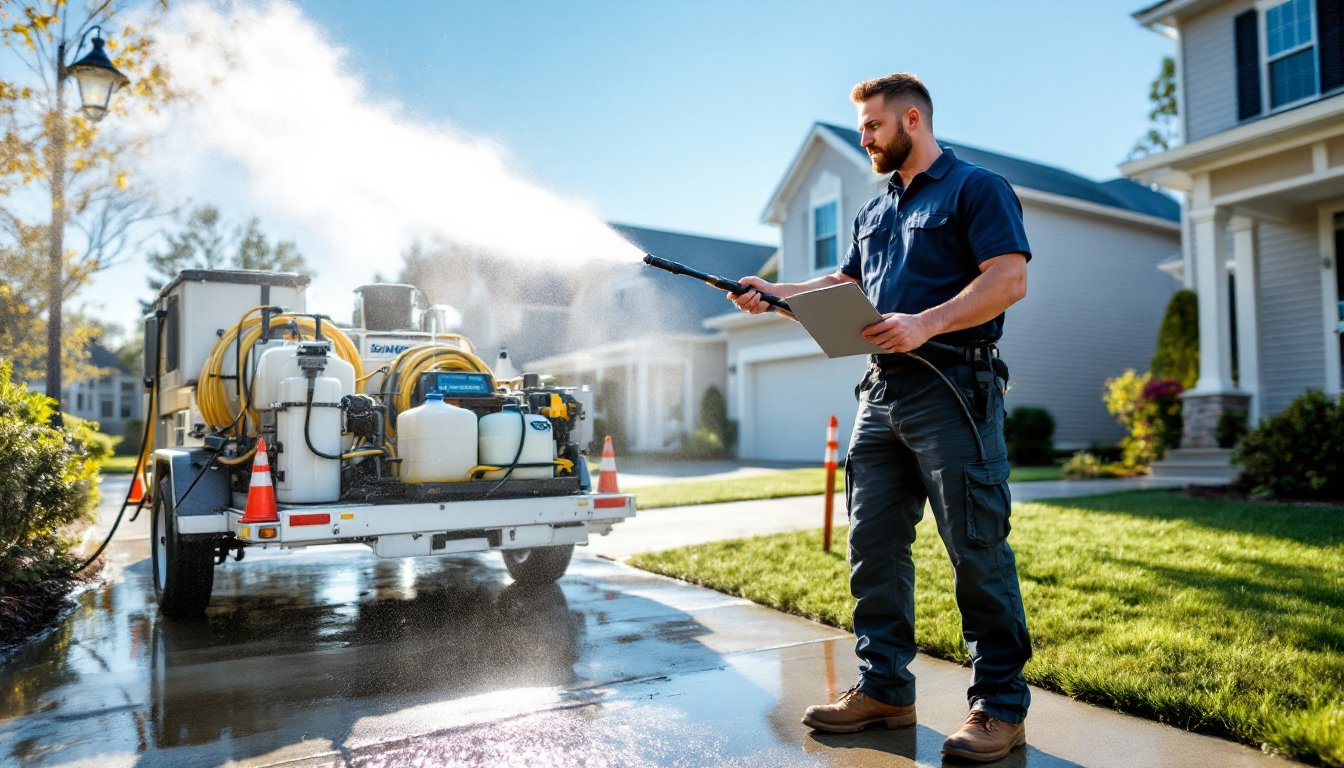
Trailers used to transport pressure washers, surface cleaners, hoses, and chemical tanks should be scheduled on the policy. Equipment transported inside a locked vehicle or trailer may have limited coverage under commercial auto, typically $1,000 to $2,500. Higher-value equipment needs separate inland marine or tools and equipment coverage (discussed below).
If employees drive company vehicles or their own vehicles for work purposes, they must be listed on the commercial auto policy. Hired and non-owned auto liability (HNOA) covers employee-owned vehicles used for business errands. This endorsement is crucial if a worker picks up supplies or drives their personal truck between job sites.
Rental trucks used occasionally for larger jobs require coverage too. Most commercial auto policies extend liability coverage to short-term rentals, but it’s worth confirming with the insurer.
Additional Coverage Types to Consider
Beyond general liability and commercial auto, several other policies provide valuable protection for pressure washing businesses.
Workers’ Compensation Insurance
If a pressure washing business has employees, workers’ compensation insurance is legally required in nearly every state. This coverage pays for medical expenses, lost wages, and disability benefits if an employee is injured on the job.
Common injuries in pressure washing include:
- Slips and falls on wet surfaces
- Muscle strains from lifting heavy equipment or climbing ladders
- Lacerations from high-pressure spray or equipment maintenance
- Chemical burns from cleaning solutions
Workers’ comp also covers occupational illnesses, such as respiratory issues from prolonged chemical exposure. Premiums are based on payroll and the business’s risk classification. Pressure washing falls under a moderate-risk category due to equipment hazards and outdoor work conditions.
Sole proprietors and LLC members typically aren’t required to carry workers’ comp for themselves, but some choose to add it for personal protection. Check state-specific regulations, requirements vary.
Equipment and Tools Coverage
Pressure washers, surface cleaners, telescoping wands, hoses, nozzles, chemical injectors, and generators represent significant investment, often $5,000 to $20,000 for a single operator, more for larger crews.
Inland marine insurance (also called tools and equipment coverage) protects business property that moves between locations. This policy covers:
- Theft of equipment from vehicles, trailers, or job sites
- Accidental damage (dropping a pressure washer off a trailer)
- Vandalism
- Fire or weather damage
Unlike commercial auto coverage, inland marine policies have higher limits and lower deductibles for tools and equipment. Coverage is typically written on a replacement cost basis, meaning the insurer pays to replace stolen or damaged items with new equivalents, not depreciated value.
Schedule high-value items individually on the policy (list serial numbers and purchase receipts). This ensures faster claims processing and avoids disputes over equipment value.
How Much Does Pressure Washing Insurance Cost?
Insurance costs vary based on revenue, coverage limits, claims history, location, and services offered. National averages provide a baseline, but actual quotes depend on individual risk factors.
General liability insurance for a pressure washing business typically costs $500 to $1,500 per year for $1 million per occurrence coverage. A sole proprietor with $50,000 in annual revenue pays toward the lower end. A multi-crew operation grossing $250,000 or more pays higher premiums.
Commercial auto insurance runs $1,200 to $2,500 annually per vehicle, depending on the vehicle type, driver records, coverage limits, and whether the policy includes collision and comprehensive coverage. Adding a trailer increases the premium modestly, usually $100 to $300 per year.
Workers’ compensation insurance costs roughly $0.50 to $2.00 per $100 of payroll for pressure washing businesses. A company with $75,000 in annual payroll might pay $1,500 to $2,500 per year. Rates drop with a clean claims history and rise after injuries.
Inland marine/tools and equipment coverage costs about 1% to 3% of the insured value annually. Insuring $10,000 in equipment typically costs $100 to $300 per year.
Bundling policies with one insurer often unlocks discounts. A business owner’s policy (BOP) combines general liability and commercial property insurance (which can cover a small office or storage unit) at a lower rate than purchasing separately. Some insurers offer BOP packages tailored to mobile service businesses.
Claims history matters. A business with no claims over three to five years qualifies for lower rates. Multiple claims, especially for property damage, increase premiums or make coverage harder to obtain. Implementing safety protocols, maintaining equipment properly, and training employees reduces risk and can improve insurability.